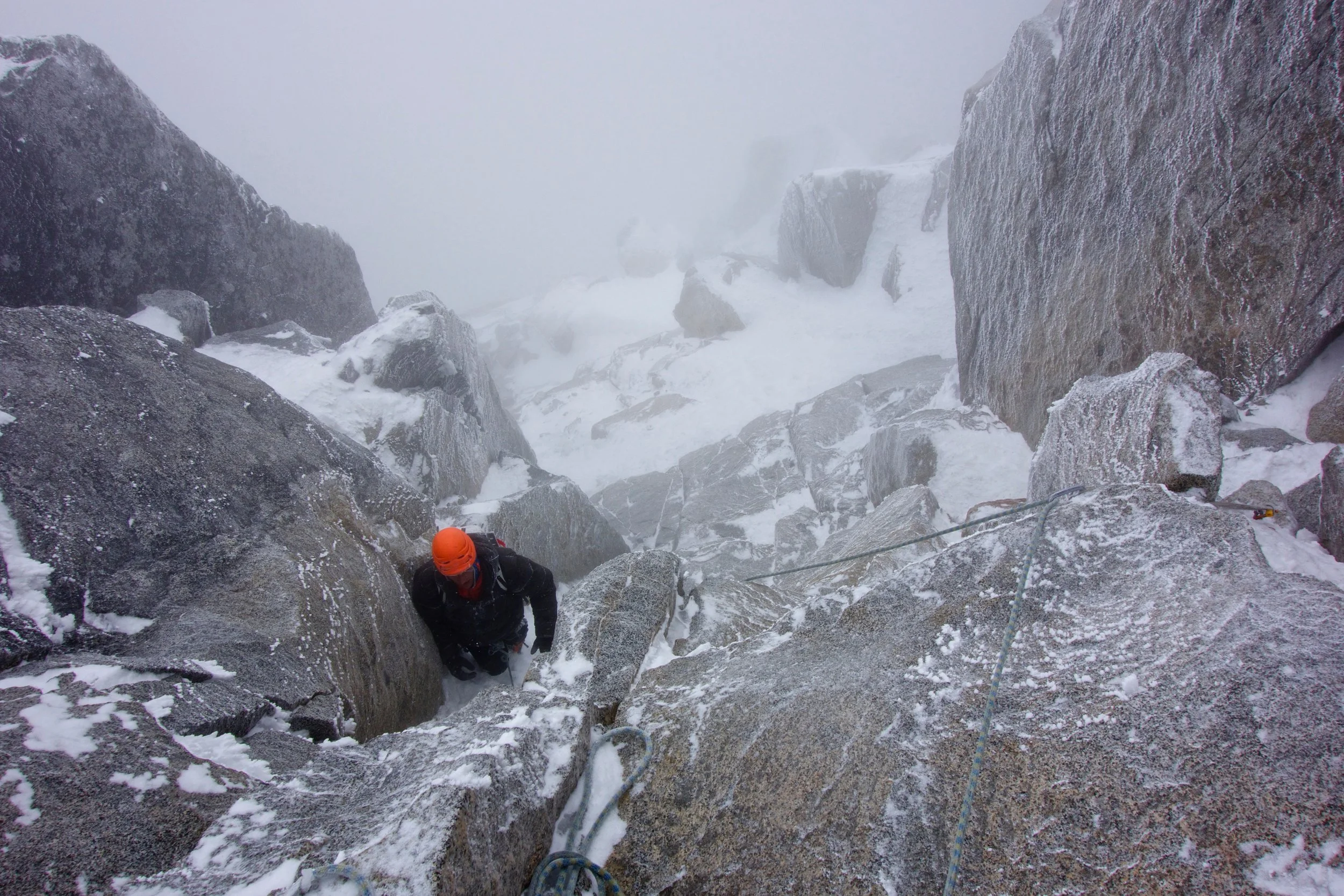
Goran leading the first chockstone pitch
After an all-nighter and smashing success on the Cauthorn-Wilson route on Saturday, followed by the longest sleep I've experienced in a while on Saturday night, Goran and I found ourselves in Mazama at 7:30am on Sunday, feeling very rested, but also a little worried at how late it was. We did a quick stop at the Mazama Store for breakfast sandwiches and coffee, then headed up to the pass. We knew from our friend Will that most of the couloir was in—he'd been up as far as the cornice solo and turned around at that point, faced with sketchy options.
Getting around the chockstone
We left the car just after 9am and made quick work of the approach, arriving at the base of the route in under an hour from the car. While the approach was baking in the morning sun, the ambient temperature was still below freezing and most of the couloir was already in the shade—we weren't too worried about conditions inside. Goran took the first chockstone pitch in the brilliant sunshine on secure neve and ran us a full rope length to a rock anchor where he brought me up. From there, it was most of a rope length again to get just below the crux chockstone where I got two good pins on the side of the couloir and brought Goran up. The snow alternated between firm neve and deeper, unconsolidated fluff.
The crux chockstone involved a mantle and stem into a corner where a #3 fit perfectly. It then took another couple of moves with bad feet to reach above the chockstone and get a good swing into neve. With two good sticks in the neve, my feet just dangled until I could lift them up around hip level and get them to stick. A bunch of spindrift flew down the couloir at this point and coated my face and sunglasses, making visibility a bit tricky. With a couple more moves, I was past it and then headed up on steep snow to a pin anchor Will had used to rap on Saturday, just below the last chockstone.
Starting to aid next to the cornice
Goran ran us from there up to a cave below the cornice a bit after noon. Options up there were daunting—right of the cornice was steep, slabby granite that looked very insecure and tough to protect, the cornice itself was quite large and we were worried that tunneling through it would cause it to collapse, and just left of the cornice was about two feet of sugary snow plastered on vertical granite. I decided to do some excavating to see if there were cracks behind all that snow and to see if any of the snow would hold body weight. I eventually found a crack, but also found that the snow fell off the face with very little downward force, so I started the painstaking process of aiding. It was about 30 feet to the top of the cornice and it took a good while, with feet in slings, tools hooking granite and pulling through the unconsolidated cornice. I slowly made my way up the face and eventually got a foot in the cornice that didn't punch through. With that, a hooked tool, and a back-step on the face, I was able to do a not-so-graceful beached-whale move onto the top of the cornice. I was elated.
Aiding over the cornice after excavating the crack
I built a good rock anchor and fixed the rope for Goran to ascend. From the grunting, I could tell it wasn't easy to make his way up the rope and clean the gear, but he eventually made it and we celebrated with high fives and snacks. The summit was tantalizingly close at that point and Goran offered to head up and give the final mixed pitch a try.
It was exactly one 70m rope length up to the belay and Goran nailed it. After some snow, neve, and hooking, most of the pitch followed a steep gully that wasn't visible from the belay, on the left of a big corner system below a roof. Most of the climbing was with crampons and bare hands and probably went at 5.6 in the summer, but felt pretty tricky as it was in these conditions. Thankfully, the rock gear was good and we pulled up onto the summit plateau of North Early Winters Spire just shy of 3:45pm. The views were stellar and we couldn't have been happier to have pulled the whole route off.
The raps were much easier to find this time and we quickly descended the gully, headed back up to the pass above South Early Winters Spire, descended with ample glissading, and were back at the car by 5pm. A truly awesome route, requiring the full back of tricks, and an awesome cap to a perfect early-season weekend at Washington Pass!
Looking back at the route from the hairpin
Summit!